
Family Support During Addiction Treatment in Turkey: How Families Can Help Recovery Without Pressure
Family Support During Addiction Treatment in Turkey: How Families Can Help Recovery Without Pressure
Addiction treatment is not only a medical journey for the patient. It is also an emotional journey for the family. Parents, spouses, siblings, and close relatives often carry fear, exhaustion, anger, guilt, and hope at the same time. They want the patient to recover, but they may not always know how to help in the right way.
For international patients considering addiction treatment in Turkey, family support can be one of the most important factors in organizing treatment, preparing for travel, communicating with medical providers, and building a realistic recovery plan after returning home.
However, family support does not mean pressure, blame, control, or emotional confrontation. True support means helping the patient enter treatment safely, stay connected to care, and return to a healthier life with structure and follow-up.
SAMHSA describes recovery as a process of change through which people improve health and wellness, live self-directed lives, and work toward their full potential. This means recovery is not a single event, but a continuing process that needs support and stability.
Why Family Support Matters in Addiction Treatment
Families are often the first people to notice that something is wrong. They may see changes in behavior, sleep, mood, finances, relationships, or responsibility. In many cases, the family is also the party that searches for treatment options, contacts medical coordinators, and helps the patient travel for care.
Research literature on family involvement in substance use disorder treatment shows that families can play an important role across the treatment and recovery process, especially when involvement is structured and supportive rather than chaotic or confrontational.
Family support may help with:
Encouraging the patient to accept treatment
Preparing medical information before travel
Communicating with treatment providers
Reducing emotional isolation
Supporting follow-up after treatment
Helping the patient avoid relapse triggers
Creating a healthier home environment
Understanding warning signs after discharge
But family support must be balanced. Too much pressure can make the patient defensive. Too little involvement can leave the patient unsupported.
The Difference Between Support and Pressure
Many families confuse support with pressure. They may believe that if they repeat warnings, monitor every action, or speak harshly, the patient will change. In reality, addiction recovery usually requires trust, structure, and professional guidance.
Pressure may sound like:
“You destroyed your life.”
“You must change immediately.”
“We do not trust you at all.”
“If you relapse, everything is over.”
“You should be cured after treatment.”
Support may sound like:
“We want to help you get proper medical care.”
“We know recovery takes time.”
“We will support treatment, but we also need healthy boundaries.”
“We want to understand the plan from the doctors.”
“We will not ignore the problem, but we will not shame you.”
Support does not mean accepting harmful behavior. It means responding in a way that protects the patient and the family while keeping treatment at the center.
What Families Should Do Before Treatment in Turkey
Before traveling for addiction treatment in Turkey, families should help organize the case clearly. This is especially important for international patients because treatment abroad requires preparation.
Families should prepare:
Substance use history
Duration and frequency of use
Previous treatment attempts
Current medications
Medical conditions
Mental health symptoms
Sleep problems
History of relapse
Family concerns
Urgency of the case
Questions for the medical team
The official HealthTürkiye platform describes itself as a central portal that helps international patients access healthcare facilities and doctors in Türkiye, which reflects the importance of organized treatment planning for patients coming from abroad.
For consultation and treatment coordination with Dr. Al-Akkad:
WhatsApp: +905379336844
Family Role During Medical Detox
Medical detox may be the first step for some patients, but it should not be treated as the full solution. Families should understand that detox helps with physical stabilization, while long-term recovery usually needs therapy, psychiatric assessment, and relapse prevention.
NIDA explains that medically assisted detoxification is only the first stage of addiction treatment and by itself does little to change long-term substance use.
During detox, families should:
Avoid panic and emotional pressure
Let the medical team manage withdrawal safely
Share accurate medical information
Ask what comes after detox
Prepare for the next treatment stage
Avoid assuming that detox means recovery is complete
The family’s role is not to control the medical process, but to support safe care and understand the next steps.
Family Role During Residential Addiction Treatment
In residential or inpatient addiction treatment, the patient stays in a structured environment. This may be important for patients who need distance from triggers, medical supervision, psychological support, and a stable recovery setting.
During this stage, families should avoid constant emotional conflict. Instead, they should focus on:
Understanding the treatment plan
Respecting the center’s communication rules
Participating in family sessions when available
Preparing the home environment before discharge
Learning how to respond to cravings or mood changes
Avoiding blame-based conversations
Residential treatment can give the patient a protected space, but the family must prepare for what happens after discharge.
For consultation and treatment coordination with Dr. Al-Akkad:
WhatsApp: +905379336844
Family Role During Outpatient Addiction Treatment
Outpatient treatment may allow the patient to receive care while living outside a facility. This requires more responsibility from both the patient and family.
Families can help by:
Encouraging attendance at appointments
Supporting a daily routine
Reducing conflict at home
Helping the patient avoid risky environments
Watching for warning signs without constant suspicion
Encouraging therapy and follow-up
Keeping communication calm and clear
Outpatient care depends heavily on consistency. The family should not treat it as a “lighter” or less serious form of treatment.
Family Support in Dual Diagnosis Cases
Some patients experience addiction together with depression, anxiety, trauma, mood instability, or sleep problems. This is known as dual diagnosis or co-occurring disorders.
In these cases, family support becomes even more important because the patient may be struggling with both addiction and emotional pain.
Families should avoid saying:
“Just stop thinking negatively.”
“You are only making excuses.”
“You finished treatment, so why are you still anxious?”
“You should be normal now.”
Instead, families should understand that mental health symptoms may need professional treatment. NIDA emphasizes that effective addiction treatment should address the broader needs of the individual, not only substance use.
Healthy Boundaries: Supporting Without Enabling
One of the most difficult parts of family support is learning the difference between helping and enabling.
Helping means supporting recovery.
Enabling means protecting the addiction from consequences.
Healthy support may include:
Helping arrange medical appointments
Encouraging treatment
Providing emotional support
Supporting healthy routines
Participating in family counseling
Helping with travel coordination
Encouraging follow-up care
Enabling may include:
Ignoring repeated harmful behavior
Giving money without accountability
Covering up consequences
Making excuses for the patient
Avoiding treatment discussions out of fear
Allowing the same high-risk environment to continue
Healthy boundaries protect both the patient and the family.
Communication Tips for Families
The way a family speaks can either support recovery or increase resistance.
Helpful communication includes:
Speak calmly
Use clear words
Avoid humiliation
Focus on treatment, not punishment
Listen before responding
Set boundaries without threats
Avoid long arguments
Encourage professional help
Praise progress without exaggeration
Discuss relapse risk realistically
The goal is not to win an argument. The goal is to keep the patient connected to recovery.
For consultation and treatment coordination with Dr. Al-Akkad:
WhatsApp: +905379336844
What Families Should Avoid During Addiction Recovery
Families should avoid common mistakes that can weaken recovery:
Expecting instant change
Assuming one treatment program solves everything
Using shame or insults
Ignoring mental health symptoms
Stopping follow-up too early
Returning the patient to old triggers
Controlling every detail of the patient’s life
Refusing family counseling
Hiding the problem completely
Treating relapse risk as a moral failure
Addiction recovery requires patience, structure, and medical guidance.
Preparing the Home After Treatment
The patient’s return home is a sensitive stage. The family should prepare the environment before discharge.
This may include:
Removing relapse triggers where possible
Creating a calm routine
Supporting sleep and meal stability
Encouraging work, study, or healthy activity gradually
Avoiding old social circles linked to substance use
Planning follow-up appointments
Agreeing on communication rules
Knowing who to contact if warning signs appear
The home should not feel like a prison. It should feel like a structured recovery environment.
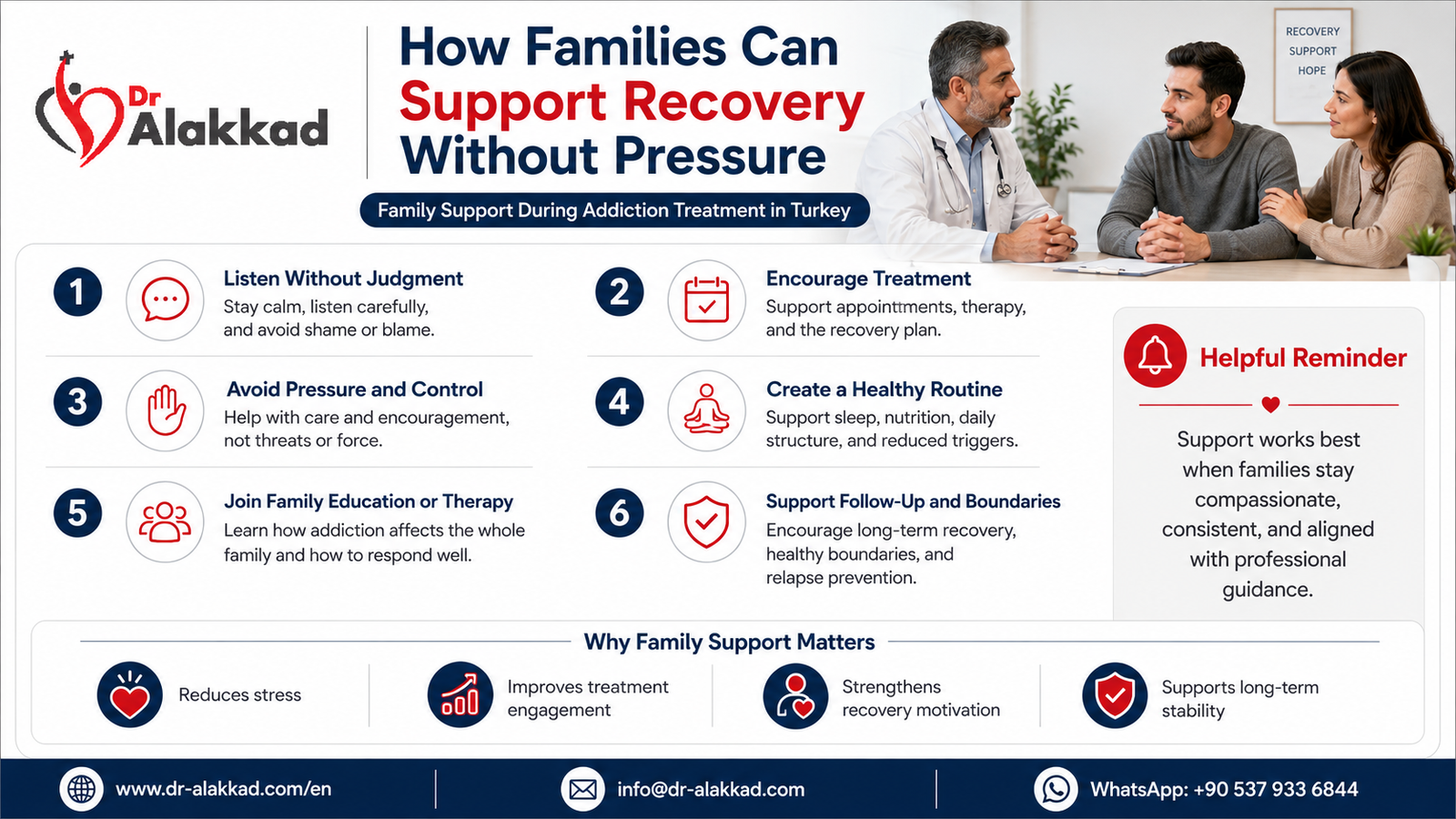
Warning Signs Families Should Watch For
Families should observe warning signs without turning every moment into interrogation.
Possible warning signs include:
Isolation
Mood instability
Avoiding follow-up
Returning to old contacts
Sleep disruption
Strong defensiveness
Loss of routine
Skipping therapy
Emotional withdrawal
Minimizing addiction risk
Increased conflict
Refusing medical support
These signs do not always mean relapse has happened. They may mean the recovery plan needs adjustment.
How Dr. Al-Akkad Can Support Families
Families often feel lost when choosing addiction treatment abroad. They may not know whether the patient needs detox, residential care, outpatient care, dual diagnosis treatment, or relapse prevention planning.
Dr. Al-Akkad can support international patients and families by helping them organize the treatment journey more clearly.
This support may include:
Initial case review
Helping the family understand treatment options
Coordinating with suitable medical providers in Turkey
Helping prepare questions before travel
Clarifying the difference between detox, rehab, outpatient care, and aftercare
Supporting communication with healthcare providers
Helping families understand warning signs
Encouraging realistic follow-up planning
Guiding the family without unrealistic promises
The goal is to help the family move from fear and confusion to a clearer, safer, and medically organized plan.
For consultation and treatment coordination with Dr. Al-Akkad:
WhatsApp: +905379336844
Cost Considerations for Families
The cost of addiction treatment in Turkey may vary depending on:
Type of treatment
Detox needs
Residential or outpatient care
Duration of stay
Psychiatric assessment
Therapy sessions
Medication review
Accommodation
Translation support
Follow-up planning
Family counseling
Families should avoid choosing treatment only by price. A cheaper option may not be suitable if the patient needs psychiatric care, medical supervision, or structured aftercare.
A responsible estimate should be based on the patient’s condition, not only on a general package.
FAQ: Family Support During Addiction Treatment in Turkey
Why is family support important during addiction treatment?
Family support can help the patient accept treatment, stay connected to care, return to a healthier environment, and continue follow-up after treatment.
Can family pressure make addiction worse?
Pressure, blame, and shame may increase resistance and emotional stress. Support should be firm, calm, and connected to professional treatment.
Should the family travel with the patient to Turkey?
This depends on the patient’s condition, treatment plan, and medical provider’s recommendation. In many cases, family involvement in coordination and discharge planning can be helpful.
Is detox enough if the family supports the patient?
Usually, detox alone is not enough. The patient may still need therapy, psychiatric assessment, relapse prevention, and follow-up care.
How can families avoid enabling addiction?
Families can avoid enabling by setting healthy boundaries, refusing to cover harmful behavior, encouraging treatment, and supporting recovery without protecting the addiction.
Can families participate in therapy?
Some treatment plans may include family counseling or family education. This depends on the provider and the patient’s needs.
How can Dr. Al-Akkad help families?
Dr. Al-Akkad can help families review the case, understand treatment options in Turkey, coordinate with suitable medical providers, and prepare a clearer recovery pathway.
Medical Disclaimer
This article is for educational purposes only. It does not replace medical evaluation, diagnosis, or treatment by a qualified doctor, psychiatrist, addiction specialist, or healthcare provider. Addiction treatment and family support plans should always be guided by licensed professionals, especially when withdrawal symptoms, mental health concerns, or safety risks are present.
Final Thoughts
Family support during addiction treatment in Turkey can make a major difference when it is calm, structured, realistic, and connected to professional care. Families should not carry the treatment burden alone, and they should not rely on pressure or blame as a strategy.
The best support combines compassion, boundaries, medical guidance, follow-up planning, and relapse prevention.
For consultation and treatment coordination with Dr. Al-Akkad:
WhatsApp: +905379336844
Suggested Internal Links
Medical Detox Treatment in Turkey
Residential Addiction Treatment in Turkey
Outpatient Addiction Treatment in Turkey
Dual Diagnosis Treatment in Turkey
Relapse Prevention After Addiction Treatment in Turkey
Drug Addiction Treatment in Turkey
Alcohol Addiction Treatment in Turkey
Addiction Treatment in Turkey