
Residential Addiction Treatment in Turkey
Residential Addiction Treatment in Turkey: Inpatient Rehab, Medical Support, and Recovery Planning
For some patients, addiction treatment cannot succeed through short consultations or occasional therapy sessions alone. When addiction becomes severe, repeated, risky, or connected to an unstable home environment, the patient may need a structured place where recovery becomes the main focus every day. This is where residential addiction treatment can play an important role.
Residential addiction treatment, also called inpatient rehabilitation, means the patient stays in a supervised treatment environment for a period of time. The goal is not only to stop alcohol or drug use, but also to provide medical assessment, psychological support, daily structure, relapse prevention, and a safer environment away from triggers.
For international patients, residential addiction treatment in Turkey may be considered when privacy, medical coordination, and a structured treatment pathway are needed. However, this decision should always be based on professional assessment, not only on family pressure, fear, or online advertisements.
The UNODC and WHO International Standards for the Treatment of Drug Use Disorders describe addiction treatment systems as including different settings and interventions, such as outpatient care, inpatient care, medical treatment, and psychosocial treatment, depending on the patient’s needs.
For private treatment guidance and coordination in Turkey, contact Dr. Al-Akkad through WhatsApp:
Contact Dr. Al-Akkad on WhatsApp
What Is Residential Addiction Treatment?
Residential addiction treatment is a structured program where the patient stays inside a treatment facility instead of returning home every day. This gives the patient a protected environment, daily routine, access to professional support, and time away from the situations that may fuel addiction.
Residential care may include:
Medical assessment
Detox planning when needed
Psychiatric evaluation
Individual therapy
Group therapy
Family guidance
Medication review when appropriate
Relapse prevention planning
Daily structure and recovery education
Follow-up planning after discharge
This type of treatment may be especially important when the patient cannot safely recover in the same environment where the addiction developed or continued.
When Is Residential Treatment Needed?
Residential addiction treatment is not necessary for every patient. Some patients may do well with outpatient therapy, psychiatric follow-up, family support, or online follow-up. But residential care may be more suitable when the addiction is severe or when the patient needs daily structure and monitoring.
Residential treatment may be considered when:
The patient has repeated relapses
The addiction is affecting health or safety
The home environment is unstable
The patient has strong cravings
There is easy access to substances at home
The patient has failed outpatient treatment before
There are mental health concerns
The family cannot manage the situation alone
The patient needs distance from harmful relationships or triggers
NIDA’s principles of effective addiction treatment emphasize that no single treatment is appropriate for everyone and that treatment must address the patient’s multiple needs, not only substance use.
This means the decision between residential and outpatient care should be based on assessment, severity, safety, and long-term recovery needs.
Why Some International Patients Consider Turkey
Turkey may be considered by international patients because it offers access to private healthcare coordination, medical evaluation, psychiatric support, therapy services, and rehabilitation options. For some patients, traveling abroad can also provide privacy and distance from the daily environment connected to addiction.
Patients and families may consider Turkey for residential addiction treatment because they are looking for:
Privacy and discretion
A structured treatment environment
Medical and psychiatric assessment
Distance from daily triggers
International patient coordination
Therapy and rehabilitation support
A serious recovery plan away from pressure
Post-treatment follow-up planning
However, treatment abroad is not suitable for every case. Some patients may need urgent local emergency care before travel. Others may need psychiatric stabilization, medical clearance, or family preparation before starting treatment.
This is why Dr. Al-Akkad begins with case review and careful guidance before recommending any treatment direction.
Residential Treatment Is More Than Detox
One of the most common misunderstandings is that addiction treatment means detox only. Detox may be necessary for some patients, especially when the body has developed physical dependence. But detox is only the first stage.
Residential treatment goes beyond detox. It helps the patient deal with the psychological, emotional, behavioral, and social factors behind addiction.
A patient may need to understand:
What triggers cravings
Why relapse keeps happening
How stress affects behavior
How to handle emotional pain
How to rebuild daily routine
How to avoid high-risk situations
How to repair family relationships
How to continue recovery after discharge
This is why a serious residential program should not be limited to physical stabilization. It should prepare the patient for life after treatment.
Medical Assessment Before Admission
Before entering residential addiction treatment, the patient should receive a careful assessment. This helps determine whether residential care is suitable and what level of support is needed.
Assessment may include:
Type of addiction
Duration of use
Substance or alcohol history
Previous treatment attempts
Withdrawal risk
Physical health condition
Mental health symptoms
Current medications
Family situation
Risk of relapse
Travel suitability
Safety concerns
SAMHSA explains that treatment for substance use and mental health conditions can involve different types of care, including therapy, counseling, medication management, support groups, outpatient care, intensive outpatient care, and inpatient or hospital-based care depending on patient needs.
This supports the idea that treatment should be matched to the patient, not chosen randomly.
What Happens Inside Residential Addiction Treatment?
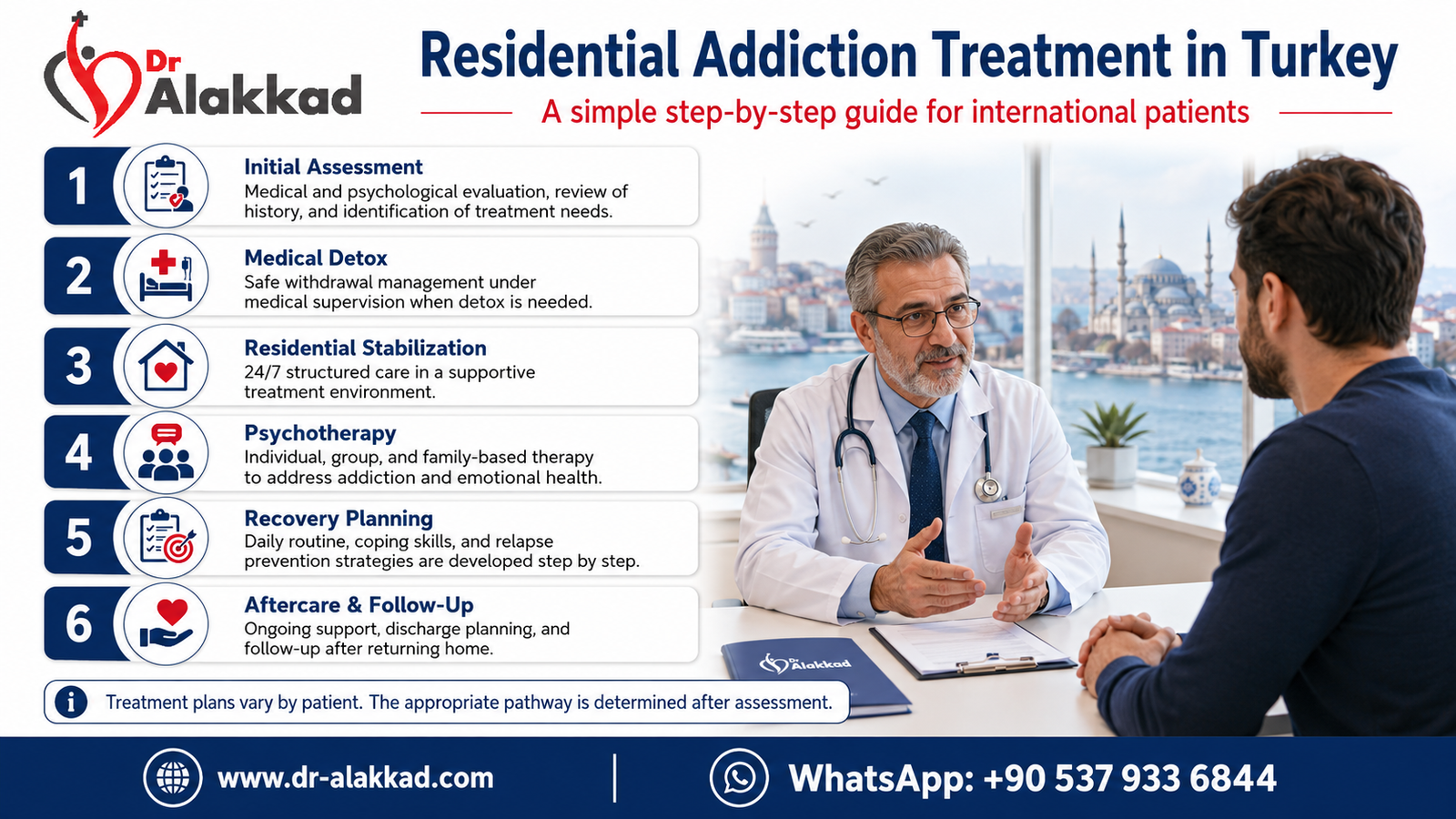
A residential addiction treatment program may vary from one center to another, but a serious program usually includes several connected stages.
1. Initial Evaluation
The patient is evaluated medically and psychologically. The team reviews the addiction history, health status, psychiatric symptoms, previous relapses, family concerns, and treatment goals.
2. Detox Planning When Needed
If detox is required, it should be medically supervised. Detox planning depends on the type of substance, physical dependence, and risk level. The purpose is to keep the patient safe and stable.
3. Psychiatric and Psychological Care
Many patients with addiction also struggle with anxiety, depression, trauma, sleep problems, or emotional instability. Residential treatment should not ignore these issues.
4. Individual Therapy
Individual therapy helps the patient understand personal triggers, emotional pain, thinking patterns, and relapse risks.
5. Group Support
Group sessions may help patients feel less isolated, learn from others, and practice communication and accountability.
6. Family Education
Family involvement may be helpful when appropriate. Families often need guidance on how to support recovery without pressure, blame, or enabling harmful behavior.
7. Relapse Prevention
Before discharge, the patient should have a clear relapse prevention plan. This is one of the most important parts of treatment.
8. Follow-Up Planning
Recovery should continue after leaving the center. Follow-up may include therapy, online consultation, psychiatric review, family support, and lifestyle planning.
Residential Treatment for Drug Addiction
Residential treatment may be useful for drug addiction when the patient has repeated relapses, severe cravings, unstable surroundings, or difficulty stopping while living at home.
Drug addiction treatment may involve medical detox, psychiatric evaluation, therapy, medication-assisted treatment when clinically appropriate, and long-term relapse prevention.
The UNODC and WHO standards emphasize evidence-based, ethical treatment and continuity of care for drug use disorders across different settings.
For international patients, residential treatment in Turkey may provide an organized path where the patient is removed from high-risk surroundings and supported through a structured recovery plan.
Residential Treatment for Alcohol Addiction
Residential treatment may also be suitable for alcohol addiction, especially when the patient has severe dependence, repeated failed attempts to stop, unsafe withdrawal risk, or major life disruption caused by drinking.
Alcohol addiction treatment may include medical assessment, detox planning, psychiatric care, therapy, medication when appropriate, family support, and relapse prevention.
The key point is safety. Some patients should not stop alcohol suddenly without medical advice, especially if there is physical dependence or previous withdrawal problems. Residential care can provide structure and supervision when needed.
Addiction Treatment in Turkey – MAT Program
Residential Treatment vs Outpatient Treatment
The difference between residential and outpatient addiction treatment is mainly the level of structure and supervision.
Residential treatment means the patient stays in a treatment setting. It may be suitable for severe cases, repeated relapse, unsafe home environments, or patients needing distance from triggers.
Outpatient treatment means the patient attends appointments but lives outside the treatment center. It may be suitable for stable patients with strong support, lower medical risk, and the ability to follow a treatment plan.
Neither option is “better” for everyone. The best option is the one that matches the patient’s condition.
How Long Does Residential Addiction Treatment Take?
There is no single correct duration for every patient. The needed time depends on the severity of addiction, mental health condition, progress during treatment, family support, relapse history, and follow-up plan.
Some patients may need a shorter residential stay followed by outpatient care. Others may need longer treatment and gradual reintegration into daily life.
The most important point is that treatment should not be judged only by the number of days. A short stay without follow-up may be weak. A longer stay without real therapy may also be incomplete. Quality, structure, and continuity matter.
Why Relapse Prevention Must Be Part of Residential Care
Residential treatment may help the patient improve inside a protected environment, but the real challenge often begins after discharge. The patient returns to normal life, stress, relationships, habits, and possible triggers.
A strong relapse prevention plan should include:
Clear warning signs
Safe daily routine
Avoidance of high-risk environments
Follow-up appointments
Family support plan
Coping strategies for cravings
Emergency plan if relapse risk increases
Therapy continuation
Lifestyle and sleep improvement
Work or education reintegration
NIDA notes that treatment plans should be assessed continually and modified as needed to fit the patient’s changing needs.
This is why residential treatment should never end with discharge only. Recovery needs continuity.
Family Role During Residential Treatment
Families are often deeply affected by addiction. They may feel exhausted, angry, afraid, or hopeless. Residential treatment can give the family time to breathe, understand the condition, and prepare for a healthier role after treatment.
Family support may include:
Learning about addiction as a health condition
Avoiding blame and humiliation
Understanding relapse warning signs
Setting healthy boundaries
Supporting follow-up care
Reducing conflict at home
Participating in family sessions when appropriate
The goal is not only to help the patient stop using. The goal is to rebuild a healthier recovery environment.
The Role of Dr. Al-Akkad
Dr. Al-Akkad helps international patients and families approach residential addiction treatment in Turkey with clarity, privacy, and medical seriousness.
This support may include:
Reviewing the patient’s condition
Understanding the addiction history
Helping determine whether residential care may be suitable
Explaining possible treatment stages
Coordinating with appropriate medical providers in Turkey
Supporting communication before and during treatment
Helping plan follow-up after discharge
The goal is to avoid random choices and help the patient receive care that fits the actual situation.
For confidential consultation:
Contact Dr. Al-Akkad on WhatsApp
Who May Benefit Most from Residential Addiction Treatment?
Residential treatment may be especially helpful for patients who:
Cannot stop while living at home
Have relapsed several times
Need medical detox
Have strong cravings
Live in a high-risk environment
Need privacy away from social pressure
Have addiction with depression or anxiety
Need daily structure and professional support
Have family conflict that affects recovery
Need a serious reset before long-term follow-up
However, the final decision should always come after professional assessment.
Residential Addiction Treatment in Turkey: Step-by-Step
Step 1: Private Contact
The patient or family contacts Dr. Al-Akkad confidentially through WhatsApp.
Start a Private WhatsApp Consultation
Step 2: Case Review
The case is reviewed, including addiction history, previous relapses, medical condition, mental health, family situation, and treatment goals.
Step 3: Treatment Direction
The patient may be guided toward residential treatment, detox, outpatient care, psychiatric evaluation, or online follow-up depending on the case.
Step 4: Coordination in Turkey
If residential treatment in Turkey is suitable, coordination may include treatment appointment planning, provider communication, and patient support.
Step 5: Follow-Up Planning
After residential care, the patient should continue follow-up to reduce relapse risk and support long-term recovery.
Final Thoughts
Residential addiction treatment in Turkey may be a suitable option for some international patients who need privacy, medical coordination, structure, and distance from daily triggers. But residential care should not be chosen simply because it sounds more serious. It should be chosen because the patient’s condition truly requires that level of support.
A responsible treatment plan begins with assessment, continues through structured care, and does not end without follow-up.
For confidential residential addiction treatment guidance in Turkey, contact Dr. Al-Akkad: