
Outpatient Addiction Treatment in Turkey: Flexible Medical Care and Recovery Support
Outpatient Addiction Treatment in Turkey: Flexible Medical Care and Recovery Support
Not every patient struggling with addiction needs to stay inside a treatment facility. Some patients may benefit from a flexible treatment plan that includes medical assessment, psychiatric support, therapy, medication review when appropriate, family guidance, and regular follow-up while continuing to live outside the treatment center.
This is known as outpatient addiction treatment.
For international patients, outpatient addiction treatment in Turkey may be an option when the patient is medically stable, motivated to receive help, and able to follow a structured treatment plan without needing full residential admission. It can also be useful after detox or residential rehabilitation as part of long-term recovery and relapse prevention.
However, outpatient treatment is not suitable for every case. The decision should depend on the patient’s medical condition, addiction severity, mental health status, family environment, safety, and relapse risk. SAMHSA lists outpatient care, residential care, therapy, counseling, peer recovery support, and medication management among treatment types that may be used depending on the patient’s needs.
For confidential case review and treatment coordination in Turkey, contact Dr. Al-Akkad through WhatsApp:
Contact Dr. Al-Akkad on WhatsApp
What Is Outpatient Addiction Treatment?
Outpatient addiction treatment is a treatment model where the patient receives care through scheduled appointments without staying full-time inside a residential facility. The patient may attend medical visits, therapy sessions, psychiatric consultations, medication reviews, and follow-up appointments while continuing to live in a hotel, home, or supervised environment.
Outpatient treatment may include:
Medical assessment
Psychiatric evaluation
Individual therapy
Family counseling
Medication review when appropriate
Relapse prevention planning
Regular follow-up
Lifestyle and recovery coaching
Online follow-up after returning home
The purpose is to provide structured care without requiring the patient to remain inside a treatment center 24 hours a day.
This option can be especially useful when the patient is stable enough to participate actively in treatment and does not need constant supervision.
Who May Benefit from Outpatient Addiction Treatment?
Outpatient addiction treatment may be suitable for selected patients. It is often considered when the addiction is mild to moderate, the patient is medically stable, and there is a supportive environment around them.
A patient may benefit from outpatient care when:
The patient is motivated to receive treatment
There is no immediate medical emergency
Withdrawal risks are low or already managed
The patient has family or caregiver support
The home or temporary living environment is safe
The patient can attend regular appointments
There is no severe psychiatric instability
The patient needs follow-up after residential care
The patient needs therapy and relapse prevention rather than full admission
NIDA’s principles of effective treatment explain that no single treatment is appropriate for everyone and that treatment should address the multiple needs of the individual, not only substance use.
This means outpatient treatment should never be chosen only because it is easier or cheaper. It should be chosen because it fits the patient’s actual condition.
When Outpatient Treatment May Not Be Enough
Outpatient care is not suitable for every patient. Some patients need a higher level of care, especially when addiction is severe or safety risks are present.
Outpatient treatment may not be enough when:
The patient has severe withdrawal risk
The patient repeatedly relapses in the same environment
There is strong craving and poor control
There are serious psychiatric symptoms
The patient is medically unstable
There is no safe support system
The home environment encourages addiction
The patient cannot attend appointments consistently
The family cannot manage the situation safely
In these cases, residential addiction treatment, inpatient care, or medically supervised detox may be more appropriate.
ASAM describes addiction treatment planning as person-centered and based on a holistic review of the patient’s needs, including addiction and co-occurring conditions.
This is why professional assessment matters before choosing between outpatient and residential treatment.
Outpatient Treatment vs Residential Treatment
The main difference between outpatient and residential addiction treatment is the level of structure and supervision.
Residential treatment means the patient stays inside a treatment facility. It may be suitable for severe addiction, repeated relapse, unsafe environments, strong cravings, or patients who need daily supervision.
Outpatient treatment means the patient attends scheduled care while living outside the facility. It may be suitable for stable patients who can follow a treatment plan and maintain safety outside the center.
Neither option is automatically better. The right option depends on the patient.
For some patients, outpatient treatment may be the first step. For others, it may be the second stage after detox or residential rehabilitation.
Why Turkey May Be Considered for Outpatient Addiction Treatment
Turkey may be considered by international patients because it offers access to private medical care, psychiatric consultations, psychological therapy, rehabilitation coordination, and international patient support.
Some patients may choose outpatient addiction treatment in Turkey because they want:
Privacy and discretion
Flexible treatment scheduling
Medical and psychological evaluation
Therapy without full residential admission
Follow-up after detox or residential treatment
A treatment plan while staying in Turkey temporarily
A bridge between intensive care and returning home
Online follow-up after leaving Turkey
For some international patients, outpatient treatment can provide a serious but flexible recovery pathway. It may be especially useful when the patient does not need 24-hour supervision but still needs professional guidance.
The First Step: Case Review Before Treatment
Before starting outpatient addiction treatment, the patient should receive a careful case review. This helps determine whether outpatient care is suitable or whether a higher level of care is needed.
A case review may include:
Type of addiction
Duration of substance use or behavior
Previous treatment attempts
Relapse history
Physical health condition
Mental health symptoms
Family support
Current medications
Withdrawal risk
Living environment
Travel suitability
Follow-up needs
SAMHSA explains that substance use treatment options may include medications, counseling, behavioral therapies, and recovery support depending on the patient’s condition.
This is why outpatient care should be personalized. Two patients may have the same addiction label, but they may need completely different treatment plans.
Outpatient Drug Addiction Treatment in Turkey
Outpatient treatment may be suitable for some patients with drug addiction, especially when the patient is stable, motivated, and does not require residential care.
Outpatient drug addiction treatment may include:
Psychiatric evaluation
Therapy sessions
Medication review when appropriate
Relapse prevention
Family counseling
Monitoring of cravings
Follow-up planning
Lifestyle rebuilding
For opioid addiction or other substance use disorders, medication may be considered by qualified medical professionals when appropriate. Medication should never be started, stopped, or changed without medical supervision.
The goal of outpatient drug addiction treatment is not only to stop substance use. It is to help the patient understand triggers, manage cravings, rebuild daily structure, and reduce relapse risk.
Outpatient Alcohol Addiction Treatment in Turkey
Outpatient care may also help selected patients with alcohol addiction. This may be appropriate when the patient is medically stable, does not need supervised detox, and can attend regular treatment sessions.
Outpatient alcohol treatment may include:
Medical evaluation
Psychiatric consultation
Therapy and counseling
Medication review when appropriate
Family guidance
Relapse prevention
Follow-up monitoring
However, alcohol withdrawal can be medically risky in some cases. Patients who have physical dependence, severe symptoms, or previous withdrawal complications should not stop suddenly without medical advice.
For these patients, detox or residential care may be safer before outpatient follow-up.
Therapy in Outpatient Addiction Treatment
Therapy is one of the central parts of outpatient addiction treatment. Addiction is often connected to stress, anxiety, depression, trauma, loneliness, family conflict, or unhealthy coping habits.
Therapy can help the patient understand:
Why addiction developed
What triggers cravings
How emotional stress affects behavior
How to avoid high-risk situations
How to rebuild self-control
How to manage guilt or shame
How to repair relationships
How to continue recovery after returning home
SAMHSA’s intensive outpatient treatment guidance discusses approaches such as cognitive behavioral therapy and other structured methods used in outpatient addiction care.
Therapy gives outpatient treatment its real strength. Without therapy and follow-up, outpatient care may become only occasional appointments without deep change.
Medication Review and Psychiatric Support
Some patients need psychiatric evaluation during outpatient addiction treatment. Addiction may appear together with anxiety, depression, sleep disorders, trauma-related symptoms, or emotional instability.
Psychiatric support may help identify whether the patient needs treatment for co-occurring mental health conditions. Medication may also be considered in some cases as part of a wider treatment plan.
Medication is not a magic solution, and it is not needed for every patient. But when clinically appropriate, it may support recovery alongside therapy, behavioral change, and follow-up.
The decision must always be made by qualified healthcare professionals.
Family Support in Outpatient Treatment
Outpatient addiction treatment often depends strongly on the patient’s environment. If the family is supportive, informed, and calm, outpatient care may have a better chance of success.
Family support may include:
Helping the patient attend appointments
Avoiding blame and humiliation
Reducing conflict at home
Learning relapse warning signs
Supporting healthy routines
Encouraging therapy and follow-up
Setting clear boundaries
Avoiding enabling harmful behavior
Families should understand that support does not mean ignoring the problem. It means helping the patient recover while also protecting the family’s emotional health and safety.
Relapse Prevention in Outpatient Care
Relapse prevention is one of the most important parts of outpatient addiction treatment. Since the patient is not inside a residential facility, they may still face daily triggers.
A strong relapse prevention plan may include:
Identifying personal triggers
Avoiding high-risk people or places
Building daily structure
Improving sleep and routine
Continuing therapy
Managing cravings
Planning for stressful situations
Involving trusted family support
Knowing what to do if warning signs appear
Scheduling follow-up appointments
NIDA emphasizes that treatment plans should be continually assessed and modified as the patient’s needs change.
This is especially important in outpatient care, because the patient’s progress must be monitored over time.
Online Follow-Up After Treatment in Turkey
For international patients, online follow-up can be very useful after leaving Turkey. The patient may return home but still need continued guidance, therapy coordination, family support, and relapse prevention monitoring.
Online follow-up may help with:
Reviewing recovery progress
Supporting relapse prevention
Guiding the family
Continuing therapy when suitable
Checking emotional stability
Planning next steps if cravings return
Online support is not a replacement for emergency care or medically supervised detox. But it can be a valuable tool for continuity after the patient returns home.
The Role of Dr. Al-Akkad
Dr. Al-Akkad helps international patients and families understand whether outpatient addiction treatment in Turkey may be suitable for their case.
This support may include:
Reviewing the patient’s situation
Understanding the type and severity of addiction
Assessing whether outpatient care is appropriate
Explaining the difference between outpatient and residential treatment
Coordinating with suitable medical providers in Turkey
Supporting communication before and during treatment
Helping plan online follow-up after returning home
The goal is to help the patient and family avoid random choices and move toward a medically responsible treatment path.
For confidential consultation:
Contact Dr. Al-Akkad on WhatsApp
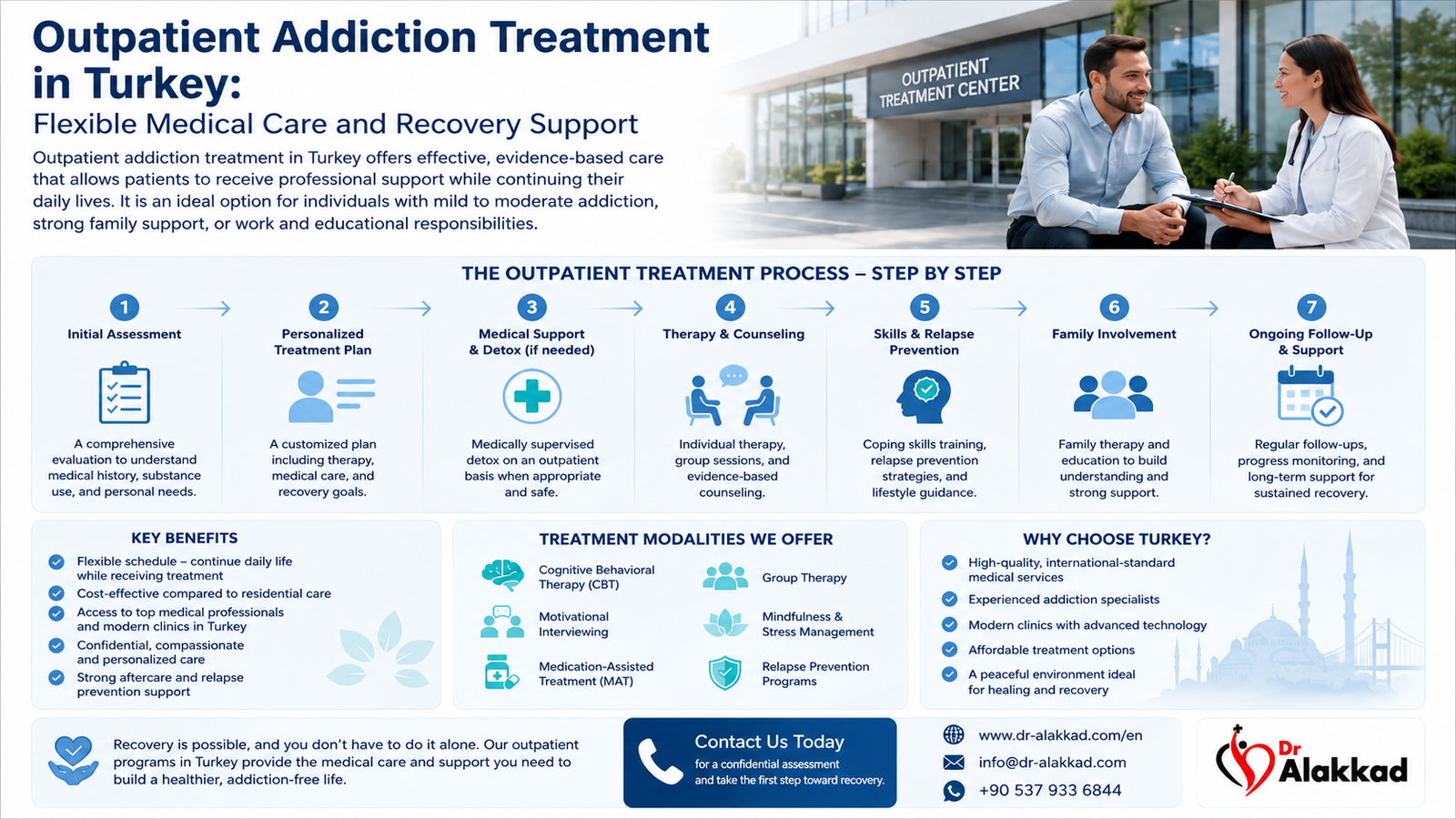
Outpatient Addiction Treatment in Turkey: Step-by-Step
Step 1: Private Contact
The patient or family contacts Dr. Al-Akkad through WhatsApp and explains the situation confidentially.
Start a Private WhatsApp Consultation
Step 2: Case Review
The patient’s addiction history, health condition, mental health status, previous treatment attempts, and family situation are reviewed.
Step 3: Suitability Assessment
Dr. Al-Akkad helps determine whether outpatient treatment may be suitable or whether residential care, detox, or urgent local care should be considered first.
Step 4: Treatment Coordination in Turkey
If outpatient care is suitable, coordination may include appointments, psychiatric evaluation, therapy planning, and follow-up arrangements.
Step 5: Recovery and Follow-Up
After treatment begins, follow-up helps monitor progress, reduce relapse risk, and support long-term recovery.
Who Is a Good Candidate for Outpatient Addiction Treatment?
A good candidate for outpatient addiction treatment may be someone who:
Is medically stable
Can attend appointments regularly
Has motivation to recover
Has a supportive environment
Does not need 24-hour supervision
Has manageable withdrawal risk
Needs therapy and relapse prevention
Can follow medical guidance
Has a clear follow-up plan
But the final decision should always be based on professional assessment.
Final Thoughts
Outpatient addiction treatment in Turkey may be a suitable option for international patients who need flexible medical care, therapy, psychiatric support, relapse prevention, and follow-up without full residential admission.
It can be a first treatment step for some patients, or a continuation after detox or residential rehabilitation. But outpatient treatment must be chosen carefully. If the patient needs a higher level of care, residential treatment or medically supervised detox may be safer.
The best treatment plan is the one that matches the patient’s real condition.
For confidential outpatient addiction treatment guidance in Turkey, contact Dr. Al-Akkad:
Contact Dr. Al-Akkad on WhatsApp